May 2026
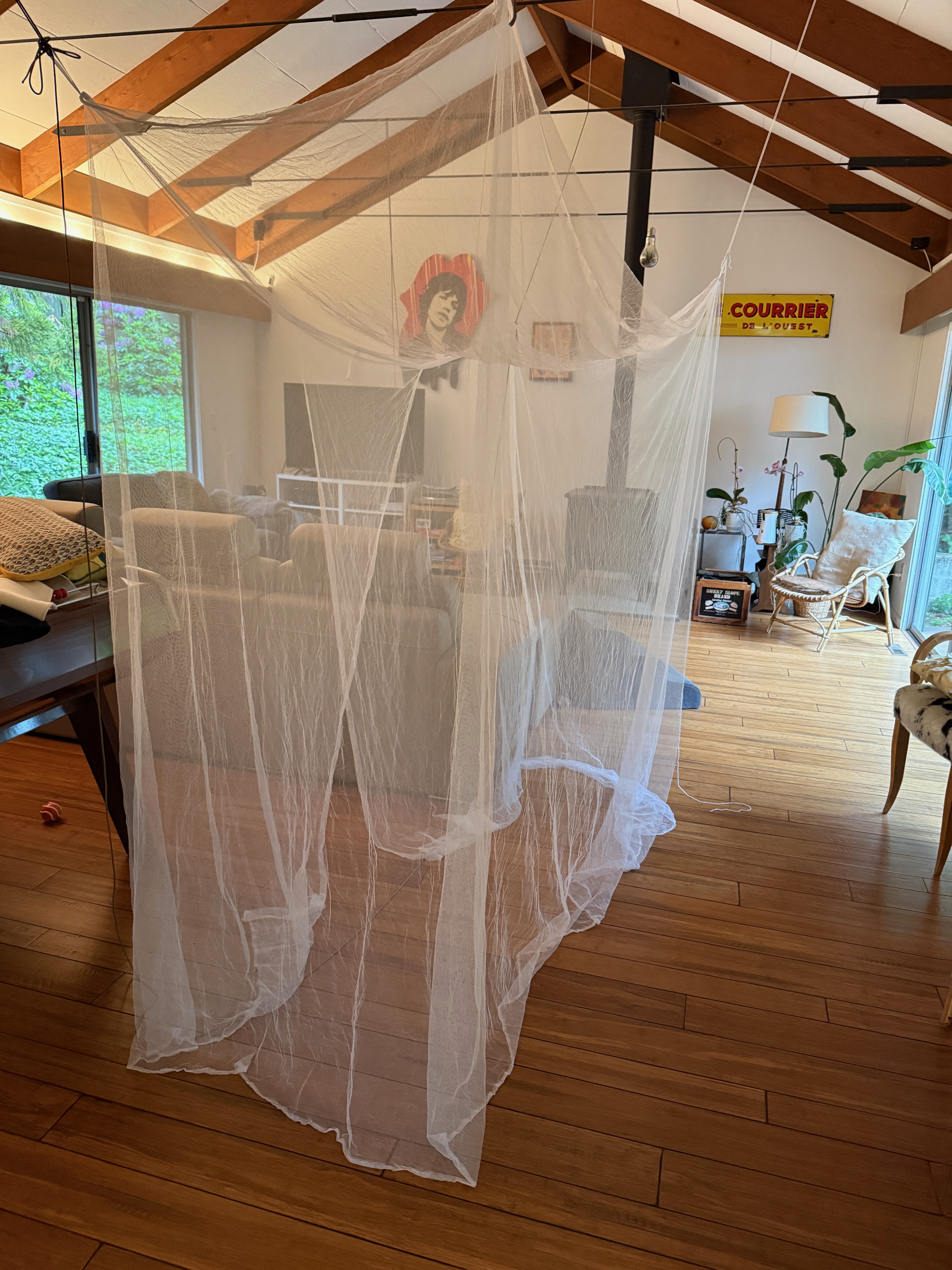
The mosquito net
The free-standing shelter goes up in the living room to check all the tension points and the ground clearance before we pack it. Bug season up there is no joke. This thing earns its weight.
How Violette and Stan picked the route, how we trained, what permits we needed, and how we're feeding two people for five days out of a single 30 L barrel. The trip happens during black-fly tail and mosquito head, in water cold enough that a capsize is the central thing we worry about.
Réserve faunique La Vérendrye covers 12,589 km² of contiguous land and lake across the Outaouais and Abitibi-Témiscamingue regions, about 180 km north of Ottawa. It is the largest contiguous wildlife reserve in Québec (the Assinica Reserve has a larger total area, but its territory is split into four non-contiguous pieces). Route 117 traverses the reserve from south to north. The small community of Le Domaine on Route 117 is where most SEPAQ services concentrate: permits, fuel, food.
The territory holds more than 4,000 lakes and rivers, two large reservoirs (Cabonga and Dozois), and 800 km of interconnecting canoe routes. This is Algonquin territory, and it is lived in, not just visited: two First Nation communities, Kitcisakik on Great Victoria Lake and Lac-Rapide (Rapid Lake) on Cabonga Reservoir, still make their home inside the boundaries and have for far longer than any of the names now printed on the map.
It is a réserve faunique first, and it shows. The territory carries one of the densest moose populations in Québec, along with black bear, grey wolf, beaver, otter, and loon. We shared the water with all of it, mostly at a distance: a moose and her calf working a far shore one morning, beaver lodges and fresh-cut poplar at the edge of the marshes, and loons calling across the lakes after dark.
The bedrock is Canadian Shield. The dominant trees are black and white spruce, jack pine, eastern white and red pine, and white birch. The reserve was established as a hunting and fishing reserve in 1939, the year the road from Mont-Laurier to Abitibi (now Route 117) was expected to open the territory to thousands of hunters and fishermen. It was renamed in 1950 for Pierre Gaultier de Varennes, sieur de La Vérendrye, the 18th-century French-Canadian explorer, on the bicentennial of his death. It gained the formal status of wildlife reserve in 1979.
Paddling Magazine calls it "a blissfully quiet alternative to Algonquin". That's the half of the appeal that the SEPAQ brochure undersells.
SEPAQ's canoe-camping programme lists nearly 20 mapped circuits in La Vérendrye, ranging from gentle 3-day loops to 14-day expedition routes with serious portages. Their own description is unsparing: "most of the circuits are designed for an independent and experienced clientele." We wanted something between those poles. Long enough to feel remote, short enough to be safe with a two-person crew, forgiving enough that one bad-weather day wouldn't blow the trip.
After weighing four candidate loops we settled on SEPAQ's Petite boucle Chochocouane n° 61, a 69 km counter-clockwise circuit in the Chochocouane sector. The loop follows the eastern bank of the Rivière Chochocouane, which is SEPAQ route n° 60 and, per Paddling Magazine, "the premier whitewater river" in La Vérendrye with class I–III rapids. We don't have the whitewater experience for the river itself. The lake chain east of it gives us the same drainage on water we know how to read.
We picked the route against a fixed list of criteria. The Petite boucle Chochocouane n° 61 was the only circuit that hit all five:
The paddling season here runs mid-May through late September. The trade-offs by window:
We went the second week of July and took out on July 11, with roughly 15.5 hours of usable light. That built margin into every paddling day. The water was warm enough to swim, and the wildlife was still out: one morning we watched a moose and her calf work the far shore. What we did not fully plan for was the weather. It swung from hot, still afternoons to cold, grey days within a few hours, and the wind on the open lakes was the real variable.
Bugs were the known cost. We carried head nets, permethrin-treated shirts, and a large free-standing mosquito shelter for the kitchen and camp. Water temperature was the second: the north lakes still ran cool, so PFDs went on before the canoe touched the water and stayed on. The rest was route discipline: hug the shore on the bigger water, no crossings if the wind was up, a dry change of clothes within reach.
A trip like this is less about peak fitness and more about durability. We built a base over the previous 18 months. Nothing fancy:
Target: 3 200 kcal/person/day. The menu is mostly dried, freeze-dried, and dehydrated: Mountain House freeze-dried pouches for breakfast and dinner, plus home-dehydrated sides and dried trail snacks. Everything is shelf-stable, packs flat, and only needs hot water from the single-burner propane stove.
Total food weight: ~5 kg for two people across five days, with one extra day's worth as safety margin. All of it lives in the bear-hung blue waterproof barrel.
Three layers, in order: avoid the situation, handle the situation, signal for help.
We pull a marine forecast from Environment Canada (Lac des Loups area) the morning of departure, and again on day 4 if we can get a clear view of the sky for the inReach to sync. No phones once we're on the water.
In rough order. None of these are deal-breakers, but they're the ones we keep coming back to.
Black bears are on the list, but low on it. A proper bear hang every night, the food barrel and anything smelly (toothpaste, sunscreen, wrappers) inside it, kitchen 50 m from the tent. Bear spray on a chest holster on the water and within arm's reach at camp. We'll be careful, not afraid.
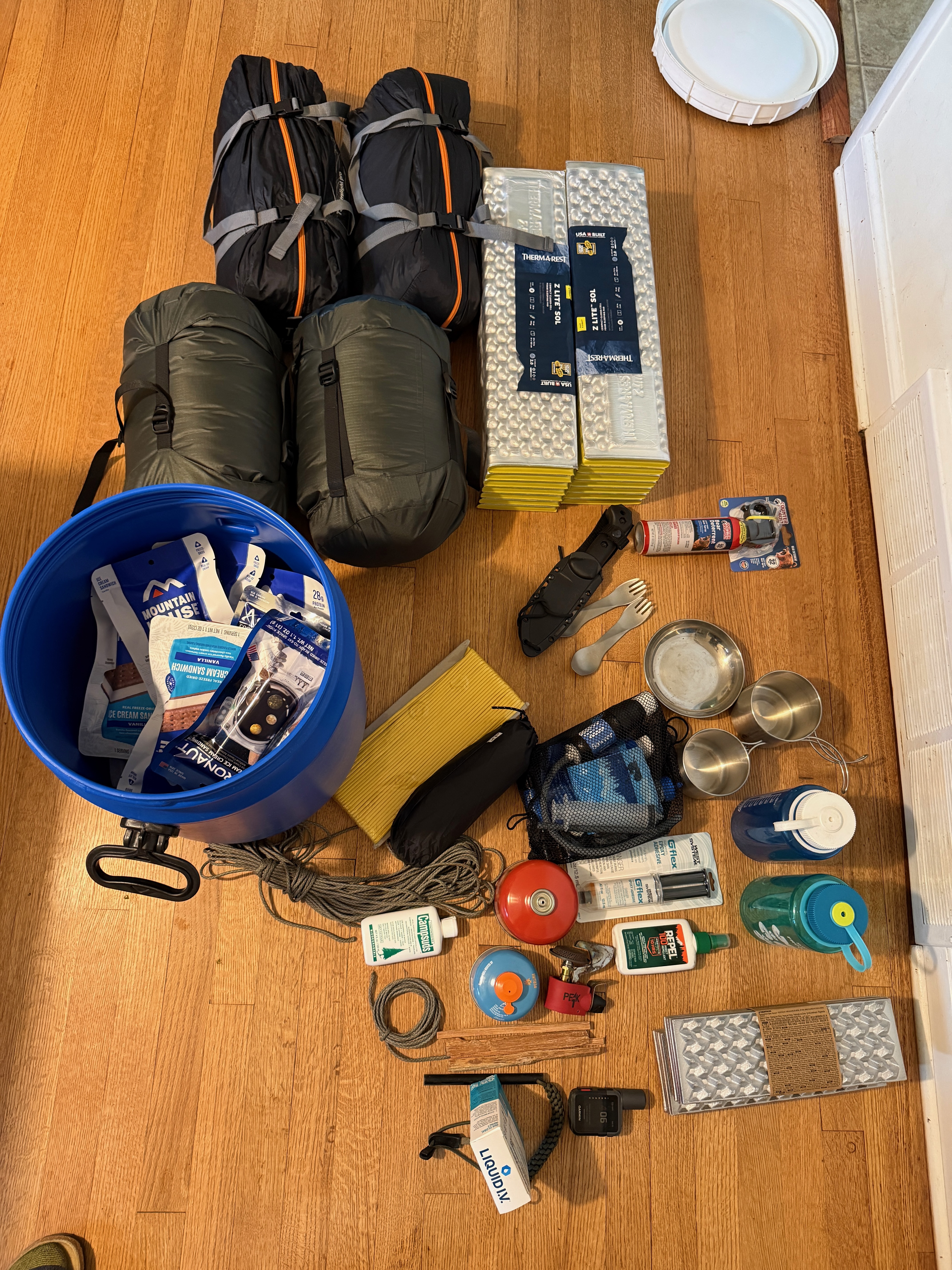
Three weeks out. The floor of the living room is covered in gear, and the mosquito net is hanging from the ceiling to check the tension points. Everything is going into the barrel one more time before the drive north.
May 2026
The free-standing shelter goes up in the living room to check all the tension points and the ground clearance before we pack it. Bug season up there is no joke. This thing earns its weight.
May 2026
Everything spread out before it goes into the barrel and the dry bags. Two sleeping bags, two pads, five days of food, kitchen, safety kit. The question we ask every time: what can we leave behind?
May 2026
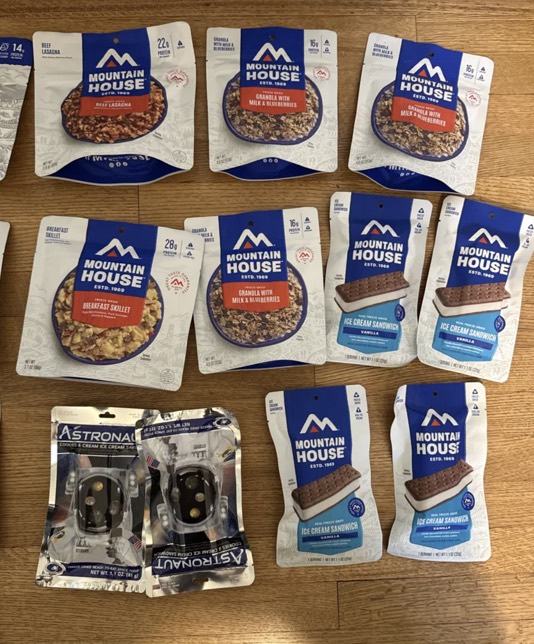
Mountain House freeze-dried breakfasts and the most important category: ice cream sandwiches at camp. Four of them. No regrets.
May 2026
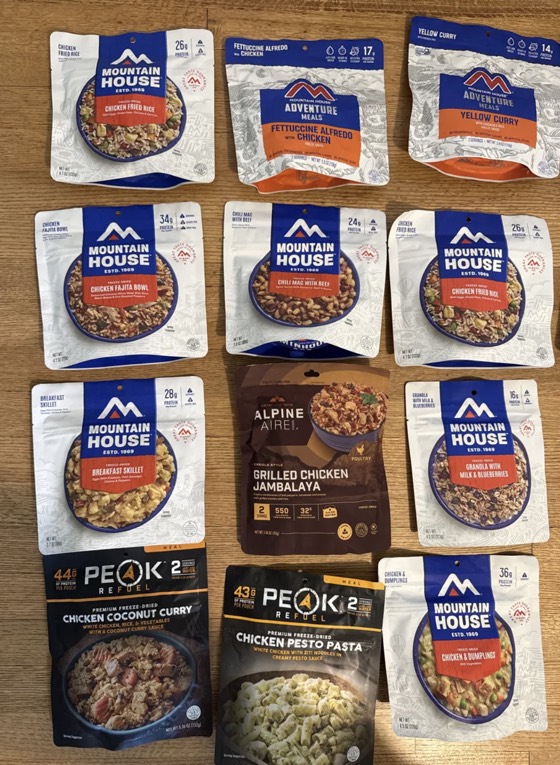
The dinner rotation: Chicken Fried Rice, Fettuccine Alfredo with Chicken, Yellow Curry, Chicken Fajita Bowl, Chili Mac with Beef. All freeze-dried, all ready in 10 minutes with boiling water.